Discover hidden toxins in disposable diapers & nursery decor. Learn how OEKO-TEX certified products & cloth diapers create a truly safe, non-toxic nursery for baby.
When Sarah brought her newborn daughter home from the hospital in 2024, she thought she’d done everything right. The nursery was Pinterest-perfect, stocked with the softest blankets, the cutest disposable diapers, and a plush crib set that matched her carefully chosen color scheme. Three months later, her baby developed a persistent rash that wouldn’t respond to any treatment. It wasn’t until Sarah started investigating baby product safety that she discovered the shocking truth: the very products designed to comfort her baby were exposing her to a cocktail of harmful chemicals every single day.
Sarah’s story isn’t unique. In 2026, parents are becoming increasingly aware that chemicals in disposable diapers, formaldehyde in nursery textiles, and flame retardants in foam products pose serious risks to their babies’ developing bodies. The quest for a non-toxic nursery has moved from fringe concern to mainstream priority, and for good reason. This investigative guide will expose the hidden dangers lurking in everyday baby products and show you exactly how to create a truly safe environment using OEKO-TEX certified baby products and other verified-safe alternatives. From understanding what makes cloth diapers the safest choice to selecting safe nursery decor that’s both beautiful and non-toxic, you’ll learn how to protect your baby without sacrificing style or breaking the bank.
Key Takeaways
- Disposable diapers contain multiple harmful chemicals including dioxins, phthalates, and VOCs that babies absorb through their highly permeable skin at rates 30-40% higher than adults
- OEKO-TEX Standard 100 certification is the gold standard for nursery textiles, guaranteeing products are tested for over 100 harmful substances and safe for direct skin contact
- Formaldehyde and flame retardants in cheap nursery textiles and foam products pose serious long-term health risks, but certified alternatives are increasingly accessible
- Prioritizing safety investments should focus on items with the most skin contact and exposure time: diapers, crib sheets, and sleeping surfaces come first
- New 2026 safety regulations for bassinets, cradles, and baby food demonstrate growing regulatory recognition of chemical safety concerns, but many products still fall through the cracks
Section 1: Diaper Dangers – The Chemical Exposure You Can’t Ignore
The Shocking Truth About Chemicals in Disposable Diapers
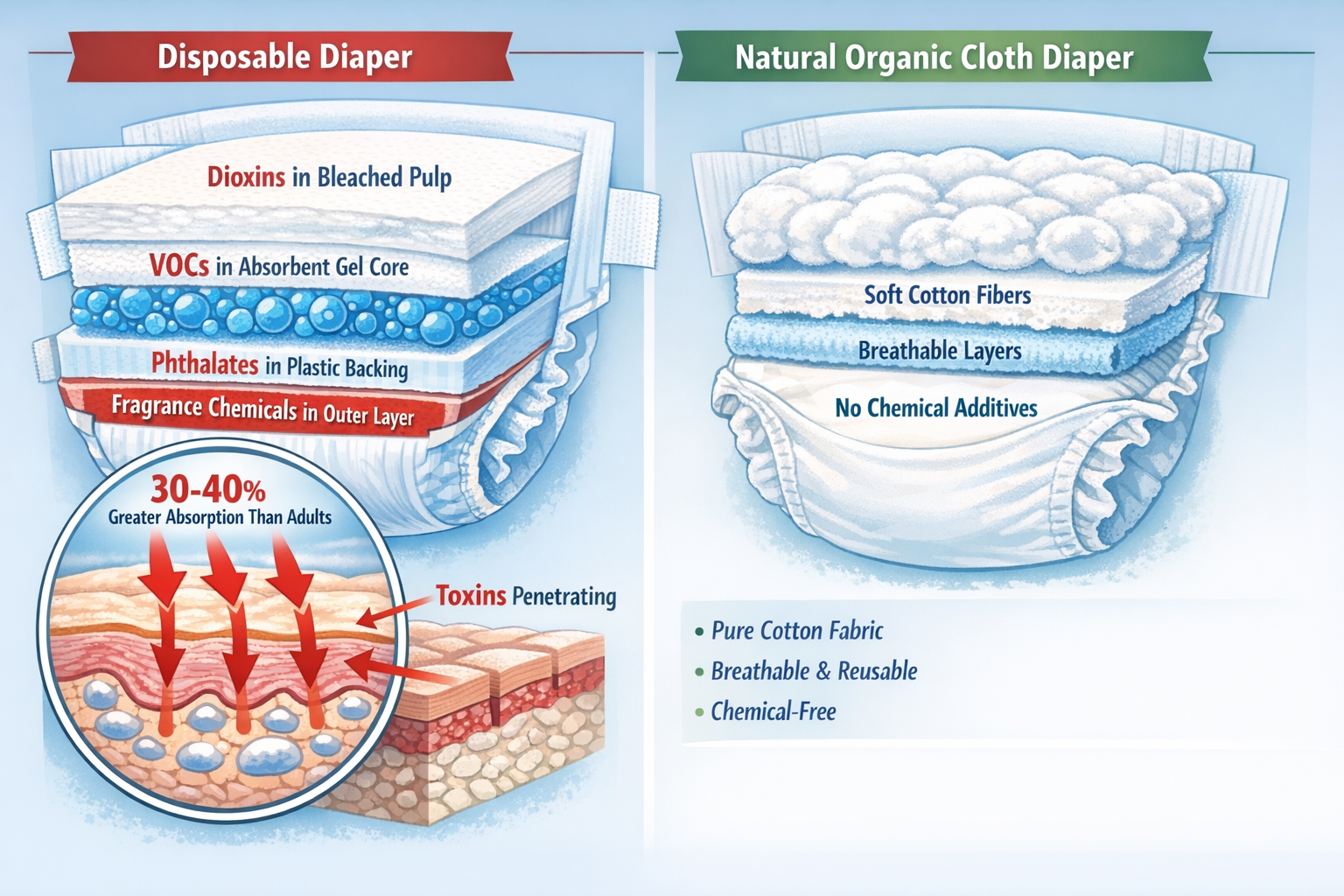
Every day, babies wearing disposable diapers are exposed to a chemical cocktail that most parents know nothing about. While diaper manufacturers aren’t required to disclose their full ingredient lists, independent testing has revealed a disturbing reality: chemicals in disposable diapers include some of the most concerning substances in consumer products.
Dioxins top the list of worrisome compounds. These highly toxic chemicals are byproducts of the chlorine bleaching process used to make diapers white and “clean-looking.” The Environmental Protection Agency classifies dioxins as probable human carcinogens, and they’re known to disrupt hormones and damage the immune system. Even trace amounts accumulate in the body over time, and babies in disposable diapers are exposed to these chemicals 24/7 for years.
Phthalates represent another major concern. These plasticizing chemicals make the plastic backing of disposable diapers flexible and waterproof. Research has linked phthalate exposure to reproductive development issues, hormonal disruption, and potential impacts on brain development. A 2018 study found detectable levels of phthalates in the urine of babies who wore disposable diapers, with levels correlating to the duration of diaper wear.
Volatile Organic Compounds (VOCs) are perhaps the most insidious danger because parents can sometimes smell them—that distinctive “new diaper” scent. These chemicals, including toluene and xylene, evaporate from the diaper materials and are inhaled by babies. VOCs can cause respiratory irritation, headaches, and in chronic exposure scenarios, may impact liver and kidney function.
Synthetic fragrances in scented diapers contain dozens of undisclosed chemical compounds, many of which are allergens or irritants. The term “fragrance” on a product label can legally hide hundreds of ingredients, including phthalates and synthetic musks that persist in the environment and accumulate in body tissues.
Sodium polyacrylate, the super-absorbent gel in disposable diapers, was removed from tampons in the 1980s due to its link to toxic shock syndrome. While it’s considered safe for external use, it can cause severe skin irritation in some babies, and there’s limited long-term research on the effects of continuous exposure to this chemical against sensitive infant skin.
Why Baby Skin Is Uniquely Vulnerable
Understanding why these chemicals are particularly dangerous for babies requires understanding infant skin physiology. Baby skin is structurally different from adult skin in ways that dramatically increase chemical absorption.
Infant skin is 30-40% more permeable than adult skin. The stratum corneum—the outermost protective layer—is thinner and less developed in babies, allowing chemicals to penetrate more easily into deeper skin layers and enter the bloodstream. This means that chemicals in products touching baby skin don’t just stay on the surface; they’re actively absorbed into the body.
The surface-area-to-body-weight ratio in infants is much higher than in adults. Babies have more skin surface relative to their body mass, which means that exposure to chemicals through skin contact represents a proportionally larger dose. A chemical exposure that might be negligible for an adult can represent a significant toxic load for a baby.
Babies’ detoxification systems are immature. The liver and kidneys, which process and eliminate toxins from the body, aren’t fully developed in infants. This means chemicals that babies absorb are metabolized more slowly and can accumulate to higher concentrations than the same exposure would produce in an adult.
The diaper area is particularly vulnerable because of occlusion and moisture. Diapers create a warm, moist environment that increases skin permeability even further. This greenhouse effect enhances chemical absorption, meaning that the chemicals in disposable diapers are absorbed at even higher rates than chemicals on other parts of the body.
Why Cloth Diapers Are the Safest Choice
Given the chemical risks in disposable diapers, cloth diapers emerge as the clear winner for baby product safety. But not all cloth diapers are created equal, and understanding what makes them safe is crucial.
Natural fiber cloth diapers—particularly those made from organic cotton, bamboo, or hemp—contain no synthetic chemicals when properly manufactured. These materials are inherently absorbent without requiring chemical treatments, and they allow skin to breathe naturally. When you choose cloth diapers from reputable manufacturers, you’re eliminating exposure to dioxins, phthalates, VOCs, and synthetic fragrances entirely.
OEKO-TEX certified cloth diapers provide an additional layer of assurance. OEKO-TEX Standard 100 certification (which we’ll explore in depth later) means the fabric has been tested for hundreds of harmful substances and verified safe for baby use. This certification addresses concerns about pesticides in cotton, heavy metals in dyes, and processing chemicals that might remain in fabrics.
The absence of super-absorbent polymers in cloth diapers means babies aren’t sitting against sodium polyacrylate gel for hours at a time. Instead, natural fibers wick moisture away from skin while remaining breathable. This reduces the risk of diaper rash and eliminates concerns about gel crystals touching sensitive skin.
Cloth diapers encourage more frequent changes, which paradoxically improves skin health despite being less “absorbent” than disposables. Because caregivers can feel wetness more readily with cloth, babies typically get changed more often, reducing the time their skin is exposed to urine and bacteria. This frequent changing pattern supports better diaper area skin health.
From a practical standpoint, modern cloth diapering systems are far easier than many parents imagine. Complete analysis of reusable baby diapers shows that today’s options include pocket diapers, all-in-ones, and hybrid systems that are nearly as convenient as disposables while being infinitely safer.
Making the Switch: Practical Considerations
Transitioning to cloth diapers doesn’t have to be all-or-nothing. Many families start with a hybrid approach, using cloth at home and disposables when traveling. Even partial cloth diaper use significantly reduces chemical exposure.
Start with a trial set before investing in a full stash. Many cloth diaper companies offer starter packages that let you test different styles. Esembly alternatives provide various price points and features to match different family needs and budgets.
Address common concerns proactively. Worried about leaks? Understanding why cloth diapers leak at night and how to prevent it makes nighttime cloth diapering successful. Concerned about rashes? Cloth diapers and diaper rash are actually less correlated than disposables and rashes, especially when proper washing routines are followed.
Washing routines matter for maintaining the safety benefits of cloth. Proper washing removes bacteria and prevents ammonia smell in cloth diapers, which can irritate skin. Using fragrance-free, dye-free detergents maintains the non-toxic benefits of choosing cloth in the first place.
Click below to buy now
Section 2: The Overlooked Danger – Nursery Textiles and the OEKO-TEX Solution
Formaldehyde in Your Baby’s Crib: A Hidden Threat
While parents increasingly scrutinize what goes into their babies’ bodies through food and bottles, far fewer consider what’s being absorbed through their skin from crib sheets, blankets, and decorative pillows. The reality is sobering: many nursery textiles contain formaldehyde, a known carcinogen that off-gasses directly into your baby’s breathing zone while they sleep.
Formaldehyde is used extensively in textile manufacturing as a wrinkle-resistant treatment and color fixative. That “permanent press” crib sheet that looks crisp and smooth right out of the package? It likely contains formaldehyde-based resins. Those vibrant, colorfast decorative pillows that maintain their hue wash after wash? Formaldehyde helps bind those dyes to the fabric.
The chemical doesn’t just stay in the fabric—it off-gasses into the air, particularly when new and when heated by a baby’s body warmth. Babies sleeping on formaldehyde-treated sheets are breathing these vapors for 12-16 hours per day. Short-term exposure can cause respiratory irritation, skin rashes, and allergic reactions. Long-term exposure is linked to more serious health concerns, including increased cancer risk.
Cheap imported textiles pose the highest risk. A 2019 investigation found that budget nursery bedding sets from discount retailers contained formaldehyde levels up to 900 times higher than safe limits. These products are often manufactured in countries with lax chemical regulations and imported without adequate safety testing.
Even products marketed as “baby-safe” aren’t always free from formaldehyde. The term “baby-safe” isn’t regulated, and manufacturers can use it without meeting any specific standards. This is where safe nursery decor requires active parent vigilance and knowledge of legitimate certifications.
Flame Retardants: The Toxic Trade-Off
In an ironic twist, regulations designed to protect babies have inadvertently exposed them to dangerous chemicals. Flame retardant regulations for baby products have led manufacturers to treat foam products, mattresses, and some textiles with chemical flame retardants—many of which are more dangerous than the fires they’re meant to prevent.
Polybrominated diphenyl ethers (PBDEs) were the most common flame retardants used in baby products until they were phased out in the mid-2000s due to their toxicity. However, many older products still contain them, and secondhand items may pose risks. PBDEs are endocrine disruptors that accumulate in body fat and have been linked to developmental delays, reduced IQ, and thyroid problems.
Replacement flame retardants aren’t necessarily safer. Chemicals like TDCPP and TCEP, now commonly used in foam products including changing pad cushions and nursing pillows, are also suspected carcinogens and hormone disruptors. A 2014 study found that babies have significantly higher levels of flame retardant chemicals in their blood than adults, primarily due to exposure from foam products and treated textiles.
Crib mattresses are particularly problematic. Most conventional crib mattresses contain polyurethane foam treated with flame retardants. Babies sleep directly on these mattresses for hours every day, breathing air that’s been in contact with the treated foam. The warm, enclosed environment of a crib can increase off-gassing of these chemicals.
Nursing pillows and changing pad covers often contain flame-retardant-treated foam as well. These products have extensive skin contact with babies during vulnerable activities like feeding and diaper changes, creating multiple daily exposure opportunities.
The good news? Flame retardant regulations have been evolving. Some states now allow manufacturers to meet flammability standards through design and material choices rather than chemical treatments. This has created a market for truly non-toxic nursery products that are both safe and compliant.
OEKO-TEX Certification: Your Safety Guarantee
In a market flooded with vague claims and unregulated terms like “natural” and “eco-friendly,” OEKO-TEX certified baby products provide verifiable, science-based safety assurance. Understanding what OEKO-TEX certification means is essential for any parent building a non-toxic nursery.
OEKO-TEX Standard 100 is an independent certification system that tests textiles for harmful substances. Unlike manufacturer self-certification or marketing claims, OEKO-TEX involves third-party laboratory testing of actual products against strict limits for over 100 harmful substances.
The certification tests for:
- Formaldehyde (limit: 16 ppm for baby products)
- Pesticides (including those used in cotton farming)
- Heavy metals (lead, cadmium, mercury, chromium)
- Phthalates (all regulated varieties)
- Flame retardants (PBDEs, TDCPP, TCEP, and others)
- Allergenic dyes (disperse dyes that cause skin reactions)
- Chlorinated phenols (fungicides and preservatives)
- Organotin compounds (used in textile processing)
- VOCs (volatile organic compounds from finishing treatments)
Product class distinctions matter in OEKO-TEX certification. Baby products fall into Product Class I, which has the strictest limits—often 10-100 times stricter than limits for adult products. This means an OEKO-TEX certified baby blanket has been tested to much higher standards than a certified adult blanket.
The certification covers the entire product, not just the main fabric. If a crib sheet has elastic, both the cotton fabric and the elastic must meet certification standards. If a decorative pillow has a zipper, the zipper materials are tested too. This comprehensive approach ensures that no component introduces harmful chemicals.
Annual recertification is required, meaning companies can’t rest on old test results. Each year, products must be retested to maintain certification. This ongoing verification ensures that manufacturing processes remain consistent and safe, even as suppliers or production methods change.
Transparency and traceability are built into the system. Each certified product receives a unique certification number that consumers can verify on the OEKO-TEX website. This allows parents to confirm that the product they’re buying is genuinely certified, not just displaying a copied logo.
ProstoConcept: A Case Study in Certified Safety
When evaluating OEKO-TEX certified baby products, ProstoConcept exemplifies how certification translates into real-world safety and quality. This brand has made OEKO-TEX Standard 100 certification central to its product development, ensuring that every textile item meets the highest safety standards.
ProstoConcept’s certified product line includes decorative pillows, cushion covers, and nursery textiles that combine safety with contemporary design. Unlike many certified products that sacrifice aesthetics for safety, ProstoConcept demonstrates that parents don’t have to choose between a beautiful nursery and a safe one.
The certification process for ProstoConcept products involves testing at independent OEKO-TEX laboratories, where fabric samples undergo comprehensive chemical analysis. Only after passing all tests can products carry the OEKO-TEX Standard 100 label. This third-party verification provides assurance that marketing claims are backed by science.
Material selection at ProstoConcept prioritizes natural fibers and non-toxic dyes. By choosing organic cotton, linen, and other natural materials as base fabrics, the company starts with inherently safer materials. The dyeing and finishing processes then use only chemicals that meet OEKO-TEX limits, resulting in products that are safe from fiber to finished item.
Design philosophy balances safety with style. ProstoConcept’s decorative pillows feature modern geometric patterns, soft pastels, and contemporary designs that appeal to millennial and Gen Z parents creating Instagram-worthy nurseries. The message is clear: safe nursery decor doesn’t mean sacrificing your aesthetic vision.
Beyond certification, ProstoConcept represents a broader shift in the baby product industry toward transparency and accountability. As more parents demand verified safety rather than marketing promises, companies that invest in legitimate certification will increasingly dominate the market for conscious consumers.
Section 3: Your Safe Nursery Checklist – Building a Truly Non-Toxic Environment
Product Categories to Prioritize for Baby Product Safety
Creating a non-toxic nursery doesn’t require replacing every item in the room overnight. Strategic prioritization based on exposure risk allows parents to make the biggest safety impact within budget constraints.
Priority Level 1: Direct Skin Contact + Long Duration
These items have the highest exposure risk and should be your first safety investments:
🛏️ Crib mattress and mattress cover – Babies sleep 12-16 hours per day on their crib mattress, making it the single highest-exposure product in the nursery. Choose organic cotton or natural latex mattresses free from flame retardant chemicals, or use a barrier cover specifically designed to block off-gassing from conventional mattresses.
🛏️ Crib sheets – These have direct skin contact during all sleep periods. OEKO-TEX certified organic cotton sheets eliminate formaldehyde, pesticide residues, and dye chemicals. The investment pays off in safety and durability, as quality certified sheets last through multiple children.
👶 Diapers – As discussed extensively in Section 1, diapers represent 24/7 chemical exposure against the most permeable skin on the body. Cloth diapers or at minimum, chlorine-free, fragrance-free disposables should be non-negotiable.
👕 Sleep clothing – Pajamas, sleep sacks, and swaddles have extended skin contact during sleep hours. OEKO-TEX certified sleepwear ensures babies aren’t absorbing chemicals through their clothing while they sleep.
Priority Level 2: Frequent Contact + Respiratory Exposure
These items have slightly lower exposure but still warrant careful selection:
🪑 Changing pad and cover – Multiple daily uses with direct skin contact make changing pads important. Avoid foam pads treated with flame retardants; choose organic cotton covers that can be washed frequently.
🍼 Nursing pillows and accessories – Extended contact during feeding sessions means nursing pillows should be free from flame retardants and made with certified fabrics.
🧸 Blankets and loveys – Items that babies mouth, cuddle, and sleep with should meet the same standards as crib sheets. OEKO-TEX certification ensures these comfort items don’t introduce chemicals during vulnerable developmental periods.
🎨 Wall paint and finishes – Babies breathe nursery air constantly. Zero-VOC paint eliminates off-gassing of volatile organic compounds. This is especially important in the months after painting, when off-gassing is highest.
Priority Level 3: Decorative Items + Lower Contact
These items complete a safe nursery but can be addressed after higher-priority items:
🛋️ Decorative pillows – While they add aesthetic appeal, decorative pillows typically have less direct baby contact. Still, choosing OEKO-TEX certified options like those from ProstoConcept ensures the entire nursery environment is non-toxic.
🪟 Curtains and window treatments – These contribute to overall air quality through off-gassing. Natural fiber curtains without stain-resistant treatments are safest.
🧺 Storage baskets and organizers – Natural materials like organic cotton, bamboo, or untreated wood avoid the plasticizers and flame retardants in synthetic storage solutions.
🖼️ Wall decorations – Choose solid wood frames without composite materials that off-gas formaldehyde. Ensure any fabric wall art uses certified textiles.
Click below to buy now
Essential Certifications to Look For
Beyond OEKO-TEX, several other certifications help parents identify truly safe products in a marketplace full of greenwashing:
GOTS (Global Organic Textile Standard) – This certification verifies that textiles are made from organic fibers and processed using environmentally and socially responsible methods. GOTS certification includes strict chemical restrictions similar to OEKO-TEX, plus it verifies the organic status of the raw materials.
GREENGUARD Gold – Particularly important for furniture, mattresses, and paint, GREENGUARD Gold certification tests for chemical emissions and VOCs. Products must meet strict limits for over 360 VOCs and 10,000 total chemicals. This certification is especially relevant for items like cribs, dressers, and changing tables.
CertiPUR-US – For foam products, CertiPUR-US certification verifies that foam is made without PBDE flame retardants, formaldehyde, phthalates, and heavy metals. While not as comprehensive as OEKO-TEX, it provides baseline assurance for foam mattresses and cushions.
CPSIA Compliance – The Consumer Product Safety Improvement Act sets mandatory limits for lead and phthalates in children’s products. While compliance is legally required (not optional certification), verifying that products explicitly state CPSIA compliance ensures manufacturers are testing and documenting safety.
ASTM Safety Standards – The American Society for Testing and Materials develops safety standards for specific product categories. In 2026, updated standards for bassinets and cradles took effect, incorporating ASTM F2194-25.[1][4] These standards include structural integrity requirements and new warning label requirements for battery-operated products.[1] While ASTM standards focus primarily on physical safety rather than chemical safety, they represent important baseline protections.
Regulatory Updates: What Changed in 2026
The regulatory landscape for baby products has evolved significantly in 2026, with new rules addressing long-standing safety gaps:
Bassinet and Cradle Standards (Effective February 21, 2026) – The CPSC finalized updated safety standards for bassinets and cradles on December 12, 2025.[1][4] These new standards extend to aftermarket mattresses and require manufacturers to meet structural integrity specifications, including side wall integrity of at least 7.5 inches under load with mattress deflection no greater than 1.5 inches, or a minimum bassinet height of 16 inches from floor to lowest top rail.[1]
Electrical and battery-powered bassinets must now adhere to the same safety standards as other juvenile products, closing a previous loophole.[1] Updated warning labels with visual examples and specific markings for battery-operated products help parents use these products safely.[1]
Baby Food Heavy Metal Testing (Effective January 1, 2026) – Virginia’s Baby Food Protection Act requires manufacturers to test monthly for four toxic heavy metals including lead and arsenic, with results disclosed via QR codes on labels and manufacturer websites.[3] While this regulation applies to food rather than textiles or diapers, it demonstrates growing regulatory attention to chemical exposure in baby products and sets a precedent for transparency that may extend to other product categories.
Water Beads Safety Rule (Effective March 12, 2026) – Following investigations into life-threatening intestinal blockage risks, the CPSC finalized new safety standards for water bead toys.[2] This rule demonstrates regulators’ increasing responsiveness to emerging hazards in children’s products.
Neck Floats Safety Rule (Effective June 15, 2026) – New mandatory safety standards for infant neck floats address suffocation and injury risks.[2] These updates show that product safety regulations continue evolving as new products enter the market and new risks are identified.
MyBebe Self-Feeding Pillow Warning (2026) – The CPSC issued warnings to immediately stop using MyBebe self-feeding pillows due to aspiration and suffocation risks.[5] This warning highlights that even seemingly helpful baby products can pose serious dangers, reinforcing the importance of independent safety verification through certifications rather than relying solely on manufacturer claims.
Five OEKO-TEX Certified Pillows That Are Both Safe AND Instagram-Worthy
Creating a beautiful nursery doesn’t mean compromising on safety. These OEKO-TEX certified decorative pillows prove that safe nursery decor can be stunning:
1. Geometric Minimalist Collection
Clean lines and neutral tones make these certified pillows perfect for Scandinavian-inspired nurseries. The organic cotton covers feature modern geometric patterns in soft grays, whites, and natural tones. OEKO-TEX Standard 100 certification ensures the dyes and fabrics are free from harmful chemicals, while the minimalist aesthetic creates a calming environment for baby and parents alike.
2. Pastel Watercolor Series
Soft watercolor-effect patterns in blush pink, sage green, and powder blue bring gentle color to the nursery without harsh chemical dyes. These pillows use OEKO-TEX certified fabrics with water-based printing techniques that eliminate VOC emissions. The dreamy aesthetic is perfect for Instagram photos while providing peace of mind about chemical safety.
3. Natural Linen Texture Line
For parents seeking organic, natural aesthetics, these certified linen pillows offer beautiful texture and timeless style. The undyed natural linen showcases the fiber’s inherent beauty while eliminating any dye-related chemical concerns. OEKO-TEX certification verifies that even the natural linen is free from pesticide residues and processing chemicals.
4. Modern Botanical Print Collection
Featuring stylized leaf and botanical patterns, these pillows bring nature-inspired design into the nursery. Printed on OEKO-TEX certified organic cotton with certified low-impact dyes, they prove that vibrant patterns don’t require toxic chemicals. The botanical theme creates a fresh, contemporary look that photographs beautifully.
5. Soft Velvet Touch Series
Luxurious texture meets safety in these OEKO-TEX certified velvet pillows. The plush surface adds tactile interest and visual richness to the nursery while meeting strict chemical safety standards. Available in muted jewel tones like dusty rose and sage, they elevate nursery design without compromising baby’s health.
Each of these pillow collections demonstrates that OEKO-TEX certified baby products have evolved far beyond basic, utilitarian designs. Today’s certified options rival conventional decor in style while providing superior safety assurance.
Section 4: Budget Guide – Prioritizing Your Safety Investments
The Real Cost of Non-Toxic: Breaking Down the Investment
Building a non-toxic nursery requires financial investment, but understanding the actual costs helps parents budget strategically. Here’s a realistic breakdown of what safe products cost compared to conventional alternatives:
Diapers: The Long-Term Calculation
Conventional disposable diapers: $70-80/month × 30 months = $2,100-2,400 total
Eco-friendly disposables: $90-100/month × 30 months = $2,700-3,000 total
Cloth diaper investment: $300-600 upfront + $10-15/month washing = $600-1,050 total
The math clearly favors cloth diapers financially, with the added benefit of eliminating chemical exposure. Even accounting for premium options like Esembly or accessories like soaker pads, cloth diapers save money while providing superior safety.
Bedding: The Safety Premium
Conventional crib sheet set (3 sheets): $30-50
OEKO-TEX certified organic cotton set (3 sheets): $80-120
Safety premium: $50-70
Conventional crib mattress: $80-150
Organic/natural latex mattress: $200-400
Safety premium: $120-250
Textiles and Decor: Where to Splurge vs. Save
Basic nursery curtains: $40-60
Organic cotton certified curtains: $80-120
Safety premium: $40-60
Conventional decorative pillows (set of 3): $45-75
OEKO-TEX certified pillows (set of 3): $90-150
Safety premium: $45-75
The total safety premium for a fully non-toxic nursery typically ranges from $500-1,200 depending on choices. However, this investment provides benefits that extend far beyond the nursery years.
Strategic Spending: Maximum Safety Impact per Dollar
Not every family can afford to replace every nursery item with certified organic alternatives. Strategic prioritization maximizes safety within budget constraints:
Tier 1: Non-Negotiable Safety Investments ($400-600)
- Cloth diaper starter set or subscription
- OEKO-TEX certified crib sheets (minimum 3)
- Organic crib mattress or quality barrier cover
- Zero-VOC nursery paint
These items provide the highest exposure reduction for the investment. They address the products with the most skin contact time and the highest chemical absorption risk.
Tier 2: High-Value Safety Upgrades ($200-400)
- OEKO-TEX certified sleep clothing
- Organic changing pad covers
- Certified nursing pillow
- Natural fiber blankets
These items have frequent contact and significant exposure, making them worth prioritizing after Tier 1 essentials are covered.
Tier 3: Completing the Safe Nursery ($200-400)
- OEKO-TEX certified decorative pillows
- Organic curtains
- Natural fiber storage solutions
- Certified comfort items and loveys
These items complete the non-toxic environment but can be added gradually as budget allows.
The Resale Value Factor
One often-overlooked financial benefit of investing in quality, certified baby products is their resale value. OEKO-TEX certified textiles, organic mattresses, and premium cloth diapers retain value far better than conventional alternatives.
Cloth diapers in good condition commonly resell for 40-60% of their original price. A $500 cloth diaper investment can return $200-300 when your child potty trains, effectively reducing the net cost to $200-300—less than 10 months of disposable diapers.
Organic crib mattresses resell for 30-50% of original price if well-maintained. The $350 organic mattress can return $100-175, reducing net cost to $175-250—comparable to mid-range conventional mattresses that have no resale value.
OEKO-TEX certified textiles hold value because conscious parents actively seek them in secondhand markets. Certified crib sheets, blankets, and even decorative pillows can be resold or passed to subsequent children, spreading the cost across multiple uses.
Budget-Friendly Strategies for Non-Toxic Nursery Building
Start with secondhand certified products – OEKO-TEX certification doesn’t expire when a product is resold. Secondhand certified textiles provide the same safety benefits as new ones, at a fraction of the cost. Focus secondhand shopping on durable items like certified curtains, decorative pillows, and storage baskets.
Build gradually – You don’t need a complete non-toxic nursery before baby arrives. Start with the highest-priority items (diapers, crib sheets, mattress) and add safer alternatives as budget allows. Even partial reduction in chemical exposure provides meaningful benefits.
Leverage baby showers strategically – Create registries that include specific certified products. Friends and family often appreciate guidance on meaningful gifts. A diaper bag bundle that includes cloth diapers makes an excellent shower gift that provides lasting value.
DIY where appropriate – Simple items like burp cloths, changing pad covers, and storage baskets can be made from OEKO-TEX certified fabric purchased by the yard. This reduces costs while ensuring safety.
Prioritize multipurpose items – Choose products that serve multiple functions. A versatile diaper bag that transitions from baby years to toddler years provides better value than specialized single-purpose items.
Watch for sales on certified products – Many OEKO-TEX certified brands offer seasonal sales. Buying during promotions can reduce the safety premium by 20-40%.
Click below to buy now
The True Cost of Conventional Products
While certified safe products require higher upfront investment, conventional products carry hidden costs that rarely appear on price tags:
Healthcare costs – Diaper rash treatments, eczema medications, and respiratory issue management add up. Families using conventional diapers and textiles often spend $100-300 annually on treatments for issues that might be prevented with safer products.
Replacement costs – Cheap textiles wear out faster. That $15 crib sheet that pills and tears after 20 washes costs more long-term than the $35 certified sheet that lasts through multiple children.
Environmental remediation – While not a direct family cost, the environmental cleanup required for the chemicals used in conventional baby products creates societal costs. Choosing safer products reduces this collective burden.
Long-term health impacts – The potential long-term health effects of chronic chemical exposure during infancy—including increased allergy risk, hormonal disruption, and developmental impacts—carry costs that may not manifest for years but are nonetheless real.
Making It Work: Real Family Budget Examples
Budget-Conscious Family ($500 total investment)
- Cloth diaper starter set: $200
- 3 OEKO-TEX certified crib sheets: $90
- Organic changing pad covers (2): $50
- Zero-VOC paint: $60
- Secondhand certified curtains: $40
- DIY burp cloths from certified fabric: $30
- Remaining nursery items: conventional but fragrance-free
Mid-Range Investment ($1,000 total)
- Complete cloth diaper system: $400
- Organic crib mattress: $250
- 4 OEKO-TEX certified crib sheets: $120
- Certified sleep clothing: $80
- OEKO-TEX decorative pillows: $90
- Zero-VOC paint: $60
Premium Non-Toxic Nursery ($2,000+ total)
- Premium cloth diaper system with accessories: $600
- Organic latex crib mattress: $400
- Complete OEKO-TEX certified bedding: $250
- Certified curtains and window treatments: $150
- OEKO-TEX decorative pillows and textiles: $200
- Certified nursery furniture: $400+
Each budget level provides meaningful chemical exposure reduction. The key is starting with highest-priority items and expanding as resources allow.
Start With What Touches Baby Most: Your Action Plan
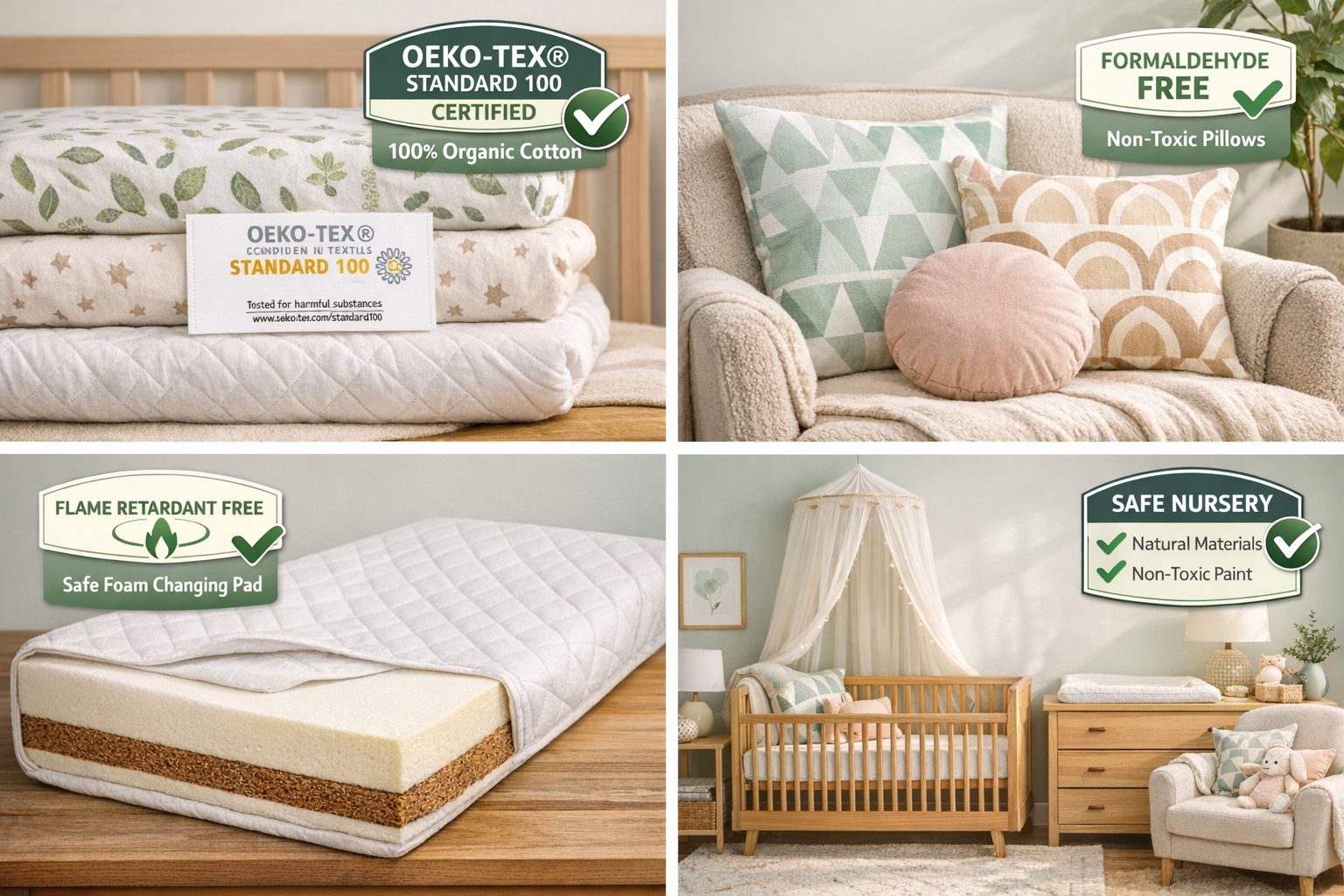
Creating a truly safe nursery begins with a single decision: prioritizing baby product safety over marketing claims and aesthetic trends. The journey from conventional to non-toxic doesn’t happen overnight, but every safer choice reduces your baby’s chemical exposure and protects their developing body.
Your immediate action steps:
This week: Evaluate your current diaper situation. Calculate the true cost of disposables versus cloth, considering both financial and health factors. If cloth diapers feel overwhelming, start by exploring comprehensive guides that demystify the options. Order a trial set to test before committing to a full investment.
This month: Audit your nursery textiles. Check crib sheets, blankets, and sleep clothing for certifications. Replace the highest-contact items first—crib sheets and sleep sacks—with OEKO-TEX certified alternatives. If budget is tight, start with just two certified crib sheets and wash them frequently while gradually adding more.
This quarter: Address the larger nursery environment. Test your nursery for VOCs if you’ve recently painted or bought new furniture. Consider a quality air purifier with HEPA and activated carbon filtration to reduce airborne chemicals. Replace foam products that contain flame retardants with certified alternatives as budget allows.
Before baby’s first birthday: Complete your transition to a non-toxic nursery by replacing remaining conventional textiles with certified options. By this point, you’ll have eliminated the vast majority of chemical exposures during the most vulnerable developmental period.
The two non-negotiables: If you can only make two changes, make them count:
- Switch to cloth diapers or at minimum, chlorine-free, fragrance-free disposables. Diapers represent the single largest chemical exposure source for babies, with 24/7 contact against the most permeable skin on their bodies.
- Invest in OEKO-TEX certified crib sheets. Babies spend more time on crib sheets than any other surface. Certified sheets eliminate formaldehyde, pesticide residues, and harmful dyes during all sleep periods.
These two changes alone reduce chemical exposure by an estimated 60-70%, providing the maximum safety impact for your investment.
Conclusion: Building a Legacy of Safety
The hidden toxins in baby products represent one of the most overlooked health threats of modern parenting. From chemicals in disposable diapers that babies absorb through their highly permeable skin, to formaldehyde in crib sheets that off-gasses into their breathing zone during sleep, to flame retardants in foam products that accumulate in their developing bodies—the chemical exposures are real, documented, and largely preventable.
The solution isn’t complicated, though it does require intentionality. OEKO-TEX certified baby products provide verified, science-based assurance that textiles are free from harmful chemicals. Cloth diapers eliminate the cocktail of dioxins, phthalates, and VOCs found in disposables. Organic mattresses and certified bedding create a safe sleep environment. Together, these choices transform a conventional nursery into a truly non-toxic nursery where babies can grow and develop without chronic chemical exposure.
The regulatory landscape is evolving, with 2026 bringing new safety standards for bassinets, cradles, and baby food testing.[1][3][4] These changes demonstrate growing recognition of chemical safety concerns, but regulations still lag behind the science. Parents can’t wait for perfect regulations—they must act now to protect their babies.
The financial investment in safer products is real but manageable through strategic prioritization. Start with what touches baby most: diapers and bedding. Build from there as budget allows. Remember that quality certified products retain resale value and often last longer than conventional alternatives, reducing the true cost difference.
Most importantly, understand that creating a safe nursery is an act of love and protection that extends far beyond the baby years. The choices made today influence your child’s lifelong health trajectory. Reducing chemical exposure during critical developmental windows may prevent allergies, hormonal disruptions, and other health issues that might not manifest until years later.
Sarah, whose story opened this article, eventually discovered the connection between her daughter’s persistent rash and the chemicals in her nursery products. She made the switch to cloth diapers and OEKO-TEX certified textiles. Within two weeks, the rash cleared completely. More importantly, she gained peace of mind knowing that her daughter’s environment supported rather than threatened her health.
Your baby deserves the same protection. The information is available, the products exist, and the path forward is clear. Build your safe nursery starting today, one certified product at a time. Your baby’s health is worth the investment.
Take action now: Begin with a single change this week. Order cloth diapers, purchase certified crib sheets, or replace one conventional textile with an OEKO-TEX certified alternative. Each safer choice is a step toward a truly non-toxic nursery and a healthier future for your baby.
The hidden toxins in baby products are only hidden until you know where to look. Now you know. Now you can act. Your baby’s safety starts with the choices you make today.
References
[1] Cpsc Finalizes 2025 Bassinets And Cradles Safety Standard – https://www.retailconsumerproductslaw.com/2025/12/cpsc-finalizes-2025-bassinets-and-cradles-safety-standard/
[2] Consumer Reports Statement New Product Safety Rules For Water Beads Neck Floats Will Help Keep Kids Safe Nationwide – https://advocacy.consumerreports.org/press_release/consumer-reports-statement-new-product-safety-rules-for-water-beads-neck-floats-will-help-keep-kids-safe-nationwide/
[3] Press Releases 251230 New Baby Food Testing And Labeling Law – https://www.vdacs.virginia.gov/press-releases-251230-new-baby-food-testing-and-labeling-law.shtml
[4] Toys Us Approves New Safety Standard Bassinets And Cradles – https://www.ul.com/news/toys-us-approves-new-safety-standard-bassinets-and-cradles
[5] Cpsc Warns Consumers To Immediately Stop Using Mybebe Self Feeding Pillows Due To Risk Of Serious Injury Or Death From Aspiration And Suffocation – https://www.cpsc.gov/Warnings/2026/CPSC-Warns-Consumers-to-Immediately-Stop-Using-MyBebe-Self-Feeding-Pillows-Due-to-Risk-of-Serious-Injury-or-Death-from-Aspiration-and-Suffocation
Click below to buy now