Complete guide comparing cloth diapers vs disposable: real costs, environmental impact, comfort factors. Save $1,500+ with informed choices for your baby.
Picture this: You’re standing in the baby aisle at 2 a.m., bleary-eyed and overwhelmed, staring at walls of diaper options. On one side, there’s the familiar convenience of disposables. On the other, colorful cloth diapers promise savings and sustainability. Your wallet whispers one thing, your conscience another, and your sleep-deprived brain just wants to know which will actually work best for your baby.
Welcome to one of parenting’s most debated decisions in 2026. The cloth diapers vs disposable debate isn’t just about what goes on your baby’s bottom—it’s about cloth vs disposable diaper cost, environmental impact, lifestyle compatibility, and yes, even your sanity. With babies using approximately 5-9 diapers daily, this choice affects your budget, your routine, and the planet for years to come[1]. Understanding the cloth diaper environmental benefits alongside practical considerations helps parents make informed decisions that align with their values and circumstances.
This comprehensive guide cuts through the marketing hype and mom-blog opinions to deliver facts, real numbers, and practical insights. Whether you’re a budget-conscious parent, an eco-warrior, or simply trying to figure out what works best for your family, you’ll find everything you need to make the right choice.
Key Takeaways
- Cost savings with cloth diapers can exceed $1,500-2,000 over the diapering years, though upfront investment ranges from $50-100 for starter kits to $800-1,000 for complete systems[1][4]
- Disposable diapers offer superior overnight absorbency with specialized beads that prevent wetness sensation, while cloth diapers require more frequent changes but may support earlier potty training[2]
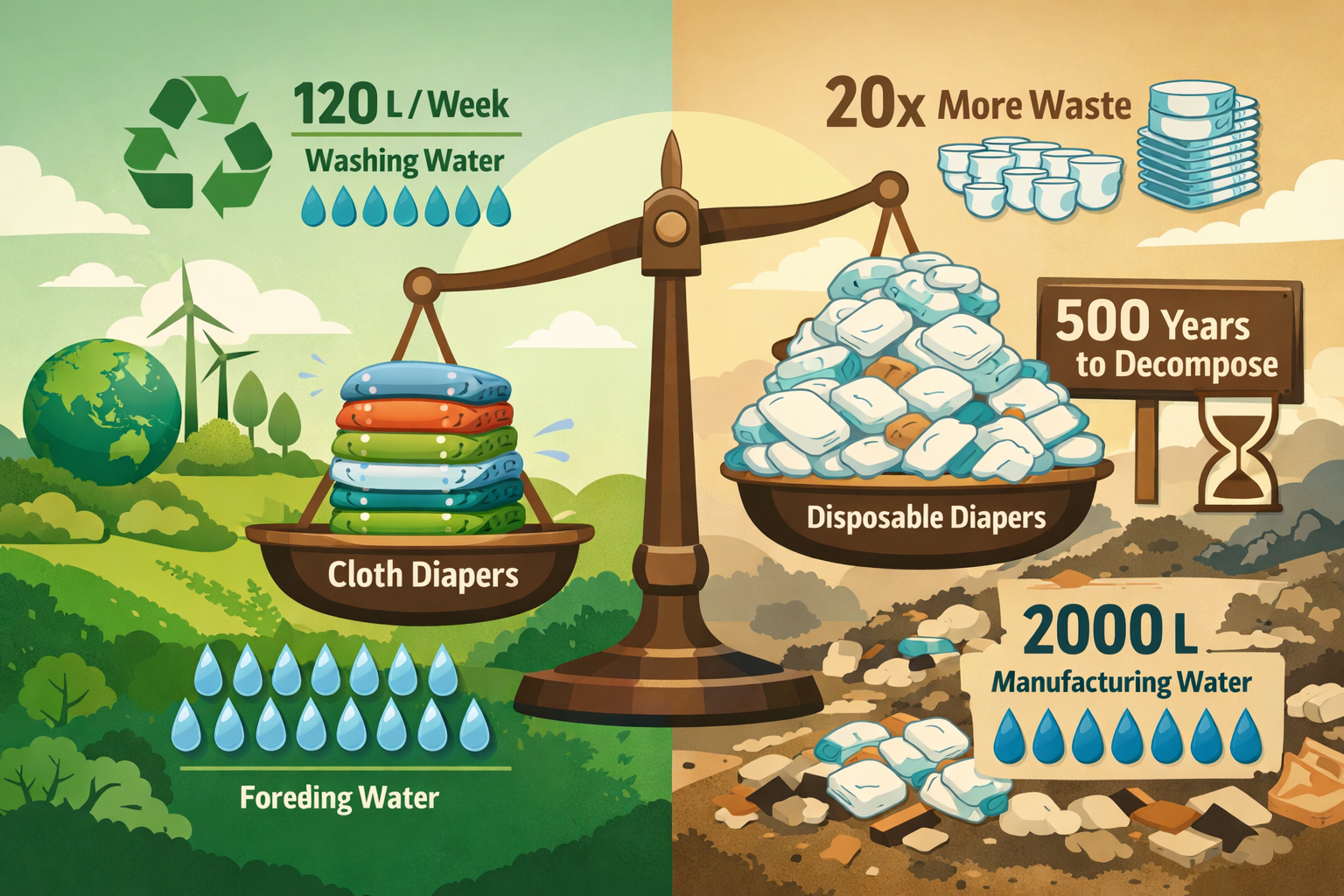
- Environmental impact heavily favors cloth diapers, which produce 20 times less solid waste than disposables and require significantly less water over their lifetime (120 liters weekly for washing vs. 2,000 liters for manufacturing disposables)[1][3]
- Hybrid approaches work beautifully for many families—using cloth at home and disposables for travel, daycare, or overnight
- Both options can cause or prevent diaper rash depending on change frequency, skin sensitivity, and proper care practices
Understanding the Basics: What Makes Each Option Different
Before diving into the cloth vs disposable diaper cost comparison, let’s establish what we’re actually comparing in 2026.
What Are Modern Cloth Diapers?
Gone are the days when cloth diapers meant safety pins and plastic pants. Today’s cloth diapering systems are sophisticated, stylish, and surprisingly user-friendly. Modern cloth diapers come in several varieties:
All-in-One (AIO) Diapers function just like disposables—everything’s sewn together, making them the most convenient cloth option. Simply put them on, remove when soiled, and toss in the wash.
Pocket Diapers feature a waterproof outer shell with an opening where you stuff absorbent inserts. This design allows customization for heavy wetters or overnight use.
Prefolds and Covers represent the most economical option, using rectangular absorbent cloths folded and secured with snaps or Velcro, then covered with a waterproof shell.
Hybrid Systems combine reusable covers with disposable or washable inserts, offering flexibility for different situations.
For parents exploring their options, our complete guide to reusable diapers provides detailed comparisons of popular brands and systems.
What’s Inside Disposable Diapers?
Disposable diapers have evolved significantly since their 1960s introduction. Modern disposables contain:
- Super absorbent polymers (SAP) that can hold up to 30 times their weight in liquid
- Moisture-wicking layers that pull wetness away from baby’s skin
- Breathable outer layers designed to reduce heat and moisture buildup
- Elastic leg gathers and waistbands for leak prevention
The absorbent beads in disposables create that distinctive gel-like substance when wet, preventing the “wet” feeling that cloth diapers allow babies to experience[2]. This difference has implications for comfort, rash prevention, and even potty training timing.
The Real Numbers: Cloth vs Disposable Diaper Cost Breakdown 💰
Let’s talk money—because for most families, budget matters significantly.
Disposable Diaper Costs: The Ongoing Expense
The average baby will use between 6,000 and 8,000 diapers before potty training. With disposables, that’s an ongoing expense that never stops until your child is trained.
Standard Disposable Costs:
- Average cost per diaper: $0.25-0.35 (store brands) to $0.40-0.60 (premium brands)
- Daily usage: 5-9 diapers
- Monthly cost: $40-80 for standard brands, $80-120 for premium brands
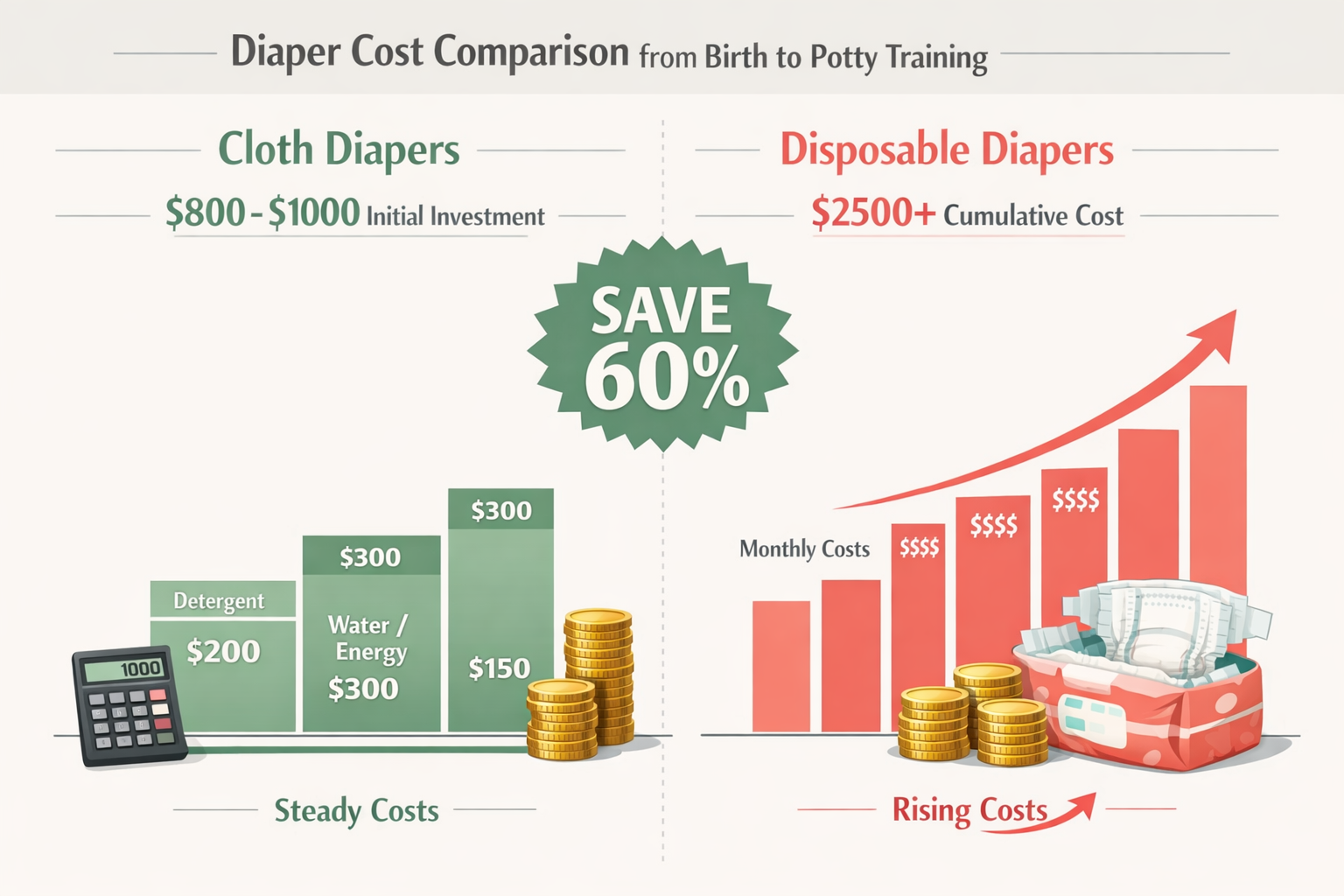
- Total cost from birth to potty training: $2,500 or more[4]
Eco-Friendly Disposable Costs:
- Biodegradable and chemical-free options: $0.50-0.80 per diaper
- Monthly cost: $90-150
- Additional cost over standard disposables: approximately $1,000[4]
These numbers assume potty training around age 2.5-3 years. Late trainers can add another $500-1,000 to these totals.
Cloth Diaper Costs: The Investment Approach
Cloth diapers flip the cost model—you pay more upfront but save dramatically over time.
Initial Investment:
- Starter kit (6-8 diapers): $50-100[1]
- Complete stash (24-36 diapers for full-time use): $300-800
- Premium systems (organic materials, designer brands): $800-1,200
- Accessories (wet bags, liners, diaper sprayer): $50-150
Ongoing Costs:
- Water and electricity for washing (2-3 loads weekly): $15-25 monthly
- Detergent: $10-15 monthly
- Occasional replacements: $50-100 annually
Total cloth diaper cost from birth to potty training: $800-1,500
The Savings Calculator
| Cost Category | Disposables | Cloth Diapers | Savings |
|---|---|---|---|
| Year 1 (10 diapers/day) | $1,200 | $700 (initial) + $300 (washing) | $200 |
| Year 2 (7 diapers/day) | $900 | $300 (washing) | $600 |
| Year 3 (4 diapers/day) | $500 | $200 (washing) | $300 |
| Total | $2,600 | $1,500 | $1,100 |
The savings grow even more dramatically with subsequent children—you’ve already made the investment, so additional kids only add washing costs.
Hidden Costs to Consider
For Disposables:
- Larger trash service or more frequent pickups
- Diaper pail liners and deodorizers
- Emergency middle-of-the-night store runs
- Environmental disposal fees in some municipalities
For Cloth:
- Stripping treatments if buildup occurs (learn more about ammonia smell issues)
- Potential need for diaper service if washing at home isn’t feasible
- Higher upfront learning curve (time = money)
- Replacement elastics or snaps after heavy use
“We calculated that our cloth diaper investment paid for itself by month seven. Everything after that was pure savings—about $150 monthly that we redirected to our daughter’s college fund.” — Sarah M., mother of two
Comfort and Performance: What Works Best for Baby’s Bottom
Cost matters, but comfort and functionality often determine which option parents stick with long-term.
Absorbency and Leak Prevention
Disposable Diaper Advantages:
Disposables excel at holding large volumes of liquid for extended periods. The super absorbent polymers can contain significantly more moisture than fabric-based alternatives, making them ideal for overnight use[2]. Most disposables are specifically designed to hold liquid for 8-12 hours without requiring changes.
Cloth Diaper Considerations:
Cloth diapers saturate faster and require more frequent changes due to their lower liquid-holding capacity[2]. However, this isn’t necessarily a disadvantage—more frequent changes can mean fresher, drier skin overall.
For parents struggling with overnight leaks in cloth diapers, our guide on why cloth diapers leak at night and how to fix it offers practical solutions including boosters, better-fitting covers, and strategic changing schedules.
The Diaper Rash Debate 🩹
Both diaper types can cause or prevent rashes—it depends on multiple factors.
Disposable Diapers and Rash:
- Better moisture management reduces prolonged wetness exposure[1]
- Chemical sensitivities can trigger reactions in some babies
- Extended wear times may lead to irritation if not changed promptly
- Fragrance and dye additives can cause contact dermatitis
Cloth Diapers and Rash:
- More breathable fabrics reduce heat and moisture buildup
- No chemical exposure for sensitive skin
- Requires more frequent changes to prevent wetness irritation
- Detergent residue or improper washing can cause reactions
The truth? Both options work well when changed frequently. The “wet” sensation in cloth diapers actually ensures parents change more often, which can reduce rash occurrence. For comprehensive information, check out our article on cloth diapers and diaper rash.
Fit, Sizing, and Adjustability
Disposable Sizing:
- Clear weight-based sizing (Newborn, 1, 2, 3, 4, 5, 6)
- Consistent fit within each brand
- No adjustment needed—grab and go
- Must buy new sizes as baby grows
Cloth Sizing:
- One-size options adjust from 8-35 pounds
- Customizable fit with multiple snap settings
- Learning curve to achieve proper fit
- Can accommodate different body types better once mastered
Understanding proper fit prevents compression leaks in cloth diapers, a common issue for beginners.
Cloth Diaper Environmental Benefits: The Sustainability Story 🌍
For many parents in 2026, environmental impact drives the diapering decision. Let’s examine the facts.
The Landfill Problem
Disposable diapers create staggering waste:
- 20 times more solid waste than cloth alternatives[1]
- Third most common consumer item in U.S. landfills[1]
- 500 years to biodegrade in anaerobic landfill conditions[1]
- Approximately 20 billion disposable diapers enter U.S. landfills annually
Each baby contributes roughly one ton of diaper waste to landfills before potty training. Multiply that by millions of babies, and the environmental impact becomes undeniable.
Water Usage: The Surprising Truth
Critics often cite water usage as cloth diapers’ environmental weakness. The reality surprises most people:
Washing Cloth Diapers:
- Approximately 120 liters of water weekly for twice-weekly washing[3]
- Total water from birth to potty training: ~15,000-18,000 liters
Manufacturing Disposable Diapers:
- Approximately 2,000 liters required to manufacture one week’s supply of disposables for one baby[3]
- Nearly 20 times more water to manufacture disposables than to wash cloth diapers from birth to potty training[3]
This calculation doesn’t even include the water required to grow and process the wood pulp, cotton, and other raw materials in disposables.
Carbon Footprint and Energy
Disposable Diaper Production:
- Petroleum-based plastics require significant energy
- Transportation of raw materials and finished products
- Single-use design maximizes resource consumption
- Chemical processing and bleaching
Cloth Diaper Production and Use:
- Higher initial manufacturing impact (especially for organic cotton)
- Energy for washing and drying (can be minimized with line drying)
- Reusable design spreads impact over thousands of uses
- Minimal transportation impact after initial purchase
Studies consistently show cloth diapers have a lower overall carbon footprint, especially when:
- Line dried rather than machine dried
- Washed in full loads with cold water
- Used for multiple children
- Made from sustainable materials
The Eco-Friendly Middle Ground
For environmentally conscious parents who aren’t ready to commit fully to cloth, several options exist:
Biodegradable Disposables:
- Made from plant-based materials
- Free from chlorine, fragrances, and harsh chemicals
- Break down faster than conventional disposables (though still slowly in landfills)
- Cost approximately $1,000 more over the diapering years[4]
Hybrid Systems:
- Reusable covers with compostable inserts
- Reduces waste while maintaining convenience
- Balances environmental impact with lifestyle needs
Diaper Services:
- Professional laundering of cloth diapers
- Economies of scale reduce environmental impact per diaper
- Convenience of disposables with sustainability of cloth
- Costs typically $75-100 monthly
Lifestyle Factors: Which Fits Your Real Life?
Numbers and environmental impact matter, but daily practicality often determines success.
Time and Convenience Considerations
Disposable Advantages:
- Zero laundry commitment
- Easy for caregivers, daycare, and babysitters
- No learning curve
- Convenient for travel
- Quick diaper changes anywhere
Cloth Advantages:
- No emergency store runs when you run out
- Always have diapers on hand
- No carrying heavy packages from the store
- Can be more convenient at home once routine is established
Time Investment for Cloth:
- 2-3 loads of laundry weekly
- Approximately 30 minutes per load (washing, hanging/folding, stuffing pockets)
- Total weekly time commitment: 1.5-3 hours
- Decreases significantly once routine is established
Daycare and Caregiver Compatibility
Many daycare centers resist cloth diapers, citing health code concerns or staff training issues. In 2026, attitudes are shifting as modern cloth systems become more familiar, but obstacles remain.
Making Cloth Work at Daycare:
- Choose all-in-one systems that function like disposables
- Provide clearly labeled wet bags for soiled diapers
- Offer to do an in-service training for staff
- Consider hybrid approach: cloth at home, disposables at daycare
Travel and On-the-Go Scenarios
Disposables Win for:
- Air travel and extended trips
- Visiting friends and family without laundry access
- Beach days and swimming (swim diapers are different)
- Situations where carrying soiled diapers isn’t practical
Cloth Works Well for:
- Day trips with access to your diaper bag
- Visiting locations with laundry facilities
- Car travel where trunk space isn’t an issue
- Routine errands around town
Having a well-organized diaper bag system makes cloth diapering on-the-go much more manageable.
Special Considerations: When One Option Clearly Wins
Certain situations make the choice clearer.
Newborn Stage Specifics
Disposables Often Better for:
- Meconium (that sticky first poop)
- Umbilical cord healing (special cutouts available)
- Figuring out sizing before investing in cloth
- Overnight hospital stays and initial recovery
Cloth Works When:
- You’ve sized correctly for newborns (8-12 pounds)
- You’re comfortable with more frequent changes
- You want to establish routine from day one
- You have newborn-specific cloth options
Potty Training Implications
Here’s an interesting consideration: cloth diapers may facilitate earlier potty training.
The “wet” sensation that cloth diapers allow helps babies develop awareness of when they’ve urinated[1]. Disposables’ moisture-wicking technology keeps babies comfortable when wet, potentially delaying the discomfort that motivates potty training.
Average Potty Training Ages:
- Cloth-diapered babies: Often train 2-6 months earlier
- Disposable-diapered babies: Average training age 2.5-3 years
Even a few months of earlier training translates to significant savings and environmental benefits.
Sensitive Skin and Allergies
Choose Cloth When:
- Baby shows reactions to disposable chemicals
- Eczema or sensitive skin is a concern
- You prefer controlling exactly what touches baby’s skin
- Fragrance-free options still cause irritation
Choose Disposables When:
- Cloth detergent causes reactions
- Frequent changes aren’t feasible
- Medical conditions require maximum dryness
- Pediatrician recommends for specific skin conditions
Understanding cloth diaper rash causes and solutions helps troubleshoot skin issues when they arise.
Making the Hybrid Approach Work 🔄
Many successful cloth-diapering families don’t actually use cloth 100% of the time. The hybrid approach offers flexibility without guilt.
Common Hybrid Strategies
The 80/20 Rule:
- Cloth at home during the day
- Disposables for overnight and outings
- Balances cost savings with convenience
- Reduces environmental impact by 70-80%
The Situational Approach:
- Cloth during normal weeks
- Disposables during travel, illness, or busy periods
- Prevents burnout and maintains sustainability commitment
- Allows flexibility for life’s unpredictability
The Progressive Approach:
- Start with disposables during the overwhelming newborn phase
- Transition to cloth around 2-3 months when routine stabilizes
- Add more cloth diapers gradually as confidence grows
- Maintain disposables as backup option
Building Your Hybrid Stash
A practical hybrid stash might include:
- 12-18 cloth diapers for daytime use
- 1-2 packs of disposables for nights and outings
- 2-3 wet bags for cloth diaper storage
- Cloth-safe diaper cream for both types
This approach provides the cost savings of cloth (you’re still using 60-70% fewer disposables) while maintaining the convenience factor for challenging situations.
Real Parent Stories: What Actually Works
Maya’s Budget-Conscious Journey:
“As a single mom, I couldn’t afford $80 monthly for disposables. I bought a $200 cloth stash secondhand and never looked back. The laundry is just part of my routine now—I wash diapers while my daughter naps. I’ve saved over $1,500 in 18 months, which paid for her toddler bed and car seat.”
The Chen Family’s Environmental Mission:
“We’re committed to reducing our carbon footprint, but we’re also realistic. We use cloth at home and keep disposables in the car for emergencies. Our daughter is in cloth about 85% of the time. It’s not perfect, but it’s significantly better than 100% disposables, and it actually works for our lifestyle.”
Derek’s Daycare Dilemma:
“Our daycare wouldn’t accept cloth diapers—period. Rather than fight it, we use disposables there and cloth at home on evenings and weekends. It’s not ideal, but we’re still preventing about 15 diapers weekly from entering landfills. That’s almost 800 diapers yearly.”
Troubleshooting Common Challenges
“Cloth diapers are leaking constantly!”
Leaks usually stem from:
- Improper fit (too loose or too tight)
- Insufficient absorbency for your baby’s output
- Compression leaks from tight clothing
- Detergent buildup reducing absorbency
- Worn-out elastic or waterproofing
Solutions include adjusting fit, adding boosters for heavy wetters, stripping diapers to remove buildup, and ensuring proper washing routines.
“I can’t handle the poop!”
Modern solutions make this easier:
- Flushable liners catch solid waste
- Diaper sprayers attach to toilets for rinsing
- “Dunk and swish” method for breastfed babies (whose poop is water-soluble)
- Once babies eat solids, most poop rolls off into the toilet
Honestly? You’re handling poop regardless of diaper type. Cloth just requires a different method.
“My partner/caregiver refuses to use cloth”
Compromise strategies:
- Use all-in-one systems that function exactly like disposables
- Allow disposables when you’re not the one changing
- Start slowly with just a few cloth changes daily
- Demonstrate the process and address specific concerns
- Calculate the savings together—money motivates
“The smell is overwhelming”
Proper washing eliminates odors:
- Rinse soiled diapers promptly
- Store in well-ventilated wet bags or pails
- Wash every 2-3 days maximum
- Use appropriate detergent amounts
- Add extra rinse cycle if needed
- Strip diapers monthly if buildup occurs
The Complete Cost-Benefit Analysis
Let’s synthesize everything into a comprehensive comparison:
Disposable Diapers: Best For
✅ Parents prioritizing convenience above all else
✅ Families without reliable laundry access
✅ Babies in daycare centers that don’t accept cloth
✅ Parents with extremely limited time
✅ Situations requiring maximum absorbency (long car trips, overnight)
✅ Families with older babies close to potty training
Cloth Diapers: Best For
✅ Budget-conscious families wanting long-term savings
✅ Environmentally aware parents reducing waste
✅ Families planning multiple children (investment pays off dramatically)
✅ Parents with sensitive-skin babies
✅ Stay-at-home parents with time for laundry routines
✅ Families with reliable home laundry access
The Hybrid Approach: Best For
✅ Parents wanting environmental benefits with some convenience
✅ Families testing cloth before full commitment
✅ Parents with unpredictable schedules
✅ Budget-conscious families who travel frequently
✅ Anyone seeking balance between ideals and reality
Getting Started: Your Action Plan
Ready to make your decision? Here’s how to begin:
If You’re Choosing Cloth:
- Start small: Purchase a trial kit with 4-6 diapers in different styles
- Test systems: Try pockets, all-in-ones, and prefolds to find your preference
- Build gradually: Add to your stash as you determine what works
- Establish routine: Designate specific laundry days and stick to them
- Join communities: Connect with other cloth-diapering parents for support and troubleshooting
For comprehensive guidance, explore our navigating the world of cloth diapers guide.
If You’re Choosing Disposables:
- Compare brands: Test different options for fit and performance
- Buy in bulk: Subscribe to delivery services for cost savings
- Consider eco-options: Explore biodegradable alternatives if environment matters
- Watch for sales: Stock up during promotions
- Size up proactively: Prevent leaks by sizing up before diapers become too tight
If You’re Trying Hybrid:
- Define your strategy: Decide when you’ll use each type
- Build appropriate stash: Purchase enough cloth for your planned usage
- Maintain flexibility: Allow yourself to adjust the ratio as needed
- Track savings: Monitor your disposable purchases to see financial impact
- Avoid guilt: Remember that some cloth is better than no cloth
Looking Ahead: Diapering Trends in 2026 and Beyond
The diapering landscape continues evolving:
Sustainability Innovations:
- Improved biodegradable disposables that actually compost
- Rental and subscription cloth diaper services expanding
- Hybrid systems becoming more sophisticated
- Carbon-neutral manufacturing processes
Technology Integration:
- Smart diapers with wetness sensors
- Apps tracking diaper changes and patterns
- Improved absorbent materials in both cloth and disposable options
- Waterproofing that lasts longer in cloth diapers
Cultural Shifts:
- Increasing daycare acceptance of cloth diapers
- Growing normalization of cloth diapering
- More dads actively participating in diapering decisions
- Recognition of diapering choice as personal, not moral
Conclusion: Making Your Best Choice
The cloth diapers vs disposable debate doesn’t have a universal winner—it has the right answer for your family.
If you’re motivated by cloth vs disposable diaper cost savings and can commit to laundry routines, cloth diapers offer substantial financial benefits, potentially saving $1,500-2,000 over the diapering years. The cloth diaper environmental benefits are undeniable, with 20 times less waste and significantly lower water consumption over the product lifetime[1][3].
However, disposables provide unmatched convenience, superior overnight performance, and easier caregiver management. For busy families, parents without laundry access, or those prioritizing simplicity during an already overwhelming time, disposables make perfect sense.
The hybrid approach offers the best of both worlds for many families—capturing significant cost savings and environmental benefits while maintaining flexibility for life’s unpredictable moments.
Your Next Steps:
This Week:
- Calculate your current or projected diaper budget
- Assess your laundry situation and time availability
- Discuss priorities with your partner or support system
- Research local resources (diaper services, cloth diaper stores, parent groups)
This Month:
- If choosing cloth: Order a trial kit and test different systems
- If choosing disposables: Compare brands and set up subscription delivery
- If going hybrid: Purchase starter cloth stash and establish your strategy
- Connect with other parents making similar choices
Remember: You can always change your approach. Start with what feels manageable now, and adjust as you learn what works for your baby, your budget, and your lifestyle. There’s no perfect choice—only the choice that works best for your unique situation.
The diapers you choose matter far less than the love, care, and attention you give your baby. Whether that baby wears cloth, disposables, or a combination of both, you’re making an informed decision that works for your family. And that’s what great parenting looks like. 💚
References
[1] Cloth Diapers Vs Disposable – https://www.thebump.com/a/cloth-diapers-vs-disposable
[2] Watch – https://www.youtube.com/watch?v=mYze2JA1Mgw
[3] Cloth Diapers Vs Disposable Diapers Which Should You Choose – https://bayrli.com/blogs/resources/cloth-diapers-vs-disposable-diapers-which-should-you-choose
[4] Cost Comparison Cloth Diapers Vs Disposables – https://jilliansdrawers.com/pages/cost-comparison-cloth-diapers-vs-disposables